On this page
Sapphire FUE is a hair transplant technique in which follicles are harvested one by one using FUE and placed into micro-channels opened in the recipient area with sapphire-tipped blades. It takes its name from the blades used to open the channels: they are made from synthetic sapphire crystal and have an extremely sharp, smooth edge.
In classic FUE, channels are opened with steel blades or fine needles. The key difference with sapphire blades is the way they cut tissue. A cleaner incision means less trauma to surrounding tissue, less scabbing and usually faster healing. Sapphire blades are also made in different widths, so the channel size can be matched precisely to the number of hairs in each graft.
How is Sapphire FUE performed?
Sapphire FUE has three main stages: harvesting, channel opening and implantation.
- Harvesting: After local anaesthesia, follicles are extracted one by one from the donor area with micro-motor punches 0.6–0.9 mm in diameter. Extraction is spread evenly so that no sparse patches are left in the donor area.
- Sorting: The follicles are grouped under magnification into single, double and triple-hair grafts and kept in a suitable solution.
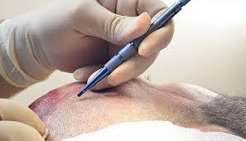
- Channel opening: Micro-channels are opened in the recipient area with sapphire blades at the planned angle, direction and density. The direction of the channels follows the exit angle of the existing hair.
- Implantation: Grafts are placed one by one into the channels with fine forceps. Single-hair grafts go at the front of the hairline, multi-hair grafts in the rows behind.
Channel opening is the most critical step for a natural result. The angle of a channel determines how the hair will stand, its direction determines how the hair will lie, and the spacing determines density. That is why this stage is planned with great care.
Advantages of Sapphire FUE
- High graft capacity: Because channels are opened in advance, implantation is quick. This allows more grafts to be placed in a single session over large areas.
- Denser placement: The fineness and sharpness of sapphire blades allow channels to be opened closer together.
- Less tissue damage: A smooth incision means less damage to surrounding tissue, with more limited scabbing and redness.
- Channels sized to fit: With blades of different widths, every graft sits in a channel that matches its size.
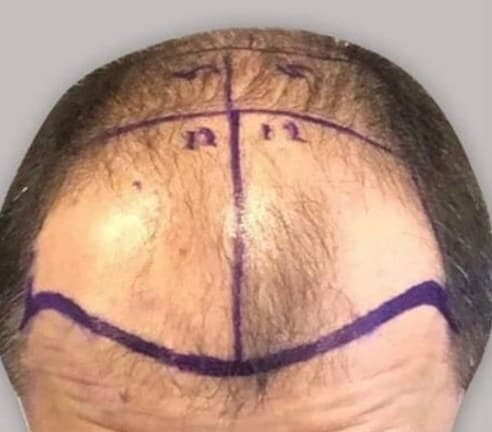
- Planning flexibility: Because the channel map is created first, density distribution can be controlled across the whole area from the start.
Who is it suitable for?
Sapphire FUE is usually preferred for:
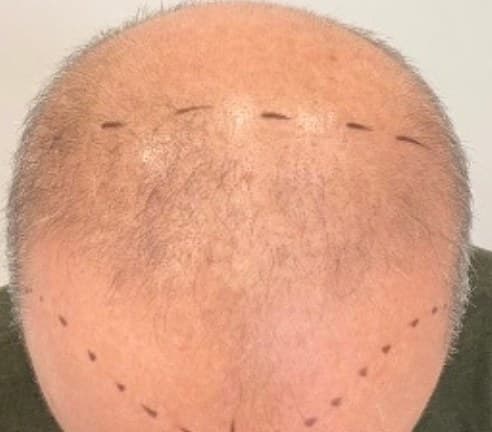
- Extensive hair loss between Norwood 4 and 7
- Cases where the front, mid-scalp and crown need to be treated in the same session
- Patients who need a high number of grafts in one session
- Patients with thick or curly hair
To understand your stage of hair loss, see our Norwood scale page. Where very fine work is needed at the hairline, the front line can be done with DHI and the remaining area with Sapphire FUE. We compare the two techniques in our FUE vs DHI guide.
How is the donor area protected?
Although Sapphire FUE makes high graft counts possible, the goal is always to plan the right number without exhausting the donor area. The hair at the back and sides is a limited resource; once a follicle is removed, it does not grow back. Over-harvesting can leave the back of the head looking thin and "moth-eaten" and can rule out a second operation that may be needed later.
That is why planning measures donor density, hair thickness and the limits of the safe extraction zone. Read our donor area guide for details.
Recovery after Sapphire FUE
On the first night, you are advised to sleep on your back with your head slightly raised. The first wash takes place at the clinic the next day. With regular washing, the scabs in the recipient area fall away in about 10 days, and the small points in the donor area close up in the same period.
From the second week, it is normal for some transplanted hairs to fall out. New hair begins to grow around month 3, and a clear change is visible by month 6. Over large areas, particularly the crown, the final look can take 12–18 months to develop. Details on washing, sleep, exercise and sun exposure are on our hair transplant aftercare page.
Frequently asked questions
What is the difference between Sapphire FUE and regular FUE?
Harvesting is the same. The difference is that channels in the recipient area are opened with sapphire blades, which make a smoother incision and make it easier to size each channel to its graft.
Does Sapphire FUE leave scars?
No linear scar is left. The extraction points in the donor area heal and are not noticeable unless the hair is cut extremely short.
How many grafts can be placed in one session?
That depends on your donor capacity and the size of the area. We can give an approximate range from your photos and confirm it at the examination.
When can I exercise after Sapphire FUE?
Light walking is possible after a few days. For weights, running and sports that make you sweat, waiting 3–4 weeks is usually recommended.
The information on this page is for general guidance only; diagnosis and treatment decisions are made by a physician after examination. Results vary from person to person.